
Breast
last authored:
last reviewed:
Introduction
Anatomy
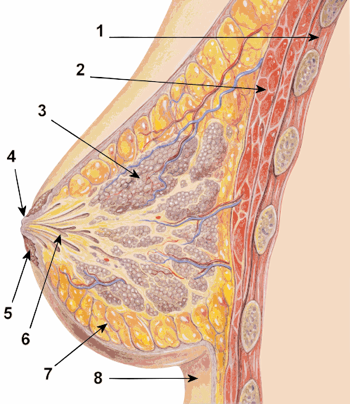
courtesy of Patrick Lynch

1: chest wall
2: pectoralis muscles
3: lobules
4: nipple
5: areola
6: lactiferous duct
7: fat
8: skin
The breast has between 4-18 ducts.
Blood supply to the breast is via the internal thoracic artery, lateral thoracic artery, thoracoacromial artery, and posterior intercostal arteries.
Lymph drains predominantly to the axillary lymph nodes
Lactation
Lactation is an important function of life. It provides the infant with the ideal source of nutrition, hydration, and protection during the first months or years.
Prolactin is an important signal for milk production, while oxytocin, which is also responsible for uterine contractions during birth, causes milk release. Once the baby is born, the sound of the baby's cry, and the suckling reflex act on higher brain centres to induce oxcytocin release and remove inhibition on prolactin release, causing both smooth muscle contraction and milk secretion.
Oxytocin It is also released as a neurotransmitter thought to reach down to the amygdala, where it may facilitate bonding and trust.
Prolactin's principal function is promoting milk production in lactating women. Levels are tonically elevated for the first three weeks after birth, after which levels fall to a lower but still elevated level. Increased pulsatile prolactin secretion is maintained as long as the mother continues to nurse.
Its effects include:
- promotion of mammary growth
- initiation of milk secretion
- maintenance of milk production
It is expressed in men as well, but its effects are not known.
Regulation of Expression
Prolactin is produced in the anterior pituitary by lactotrophs. It is constitutively released unless inhibited by dopamine, released by the arcuate nucleus in the hypothalamus.
Suckling is the most powerful physiologic cause of prolactin release, acting through spinal pathways to inhibit dopaminergic neurons in the hypothalamus. Treating women with dopamine-receptor agonists rapidly inhibits prolactin secretion and milk production. Prolactin releasing hormones from the hypothalamus include VIP and PHI-27.
Prolactin releasing factors include TRH, angiotensin II, substance P, beta-endorphin, and ADH. Estradiol increases prolactin secretion by increasing lactotroph sensitivity to TRH and decreasing sensitivity to dopamine. However, estrogen also blocks prolactin activity at the breast.
Hyperprolactinemia is most commonly caused by prolactinomas of the anterior pituitary. Increased levels of prolactin lead to amenorrhea, galactorrhea, loss of libido, and infertility.
Pathological hyperprolactinemia can result from lactotroph hyperplasia in the pituitary, as a result to inhibitory hypothalamic dopamine neurons.
Several classes of drugs can increase prolactin levels, including:
- antidepressants, particularly TCAs
- dopamine receptor antagonists - antipsychotics such as phenothaizines or haloperidol
- older antihypertensive drugs, such as reserpine and methyl-dopa
- metaclopromide
Renal failure, estrogens, and hypothyroidism, Cushing's disease, and acromegaly, can also cause elevated prolactin levels.
Hyperprolactinemia reduces estrogen, leading to long term osteoporosis and a loss of cardioprotection.
Normal LH/FSH but without normal pulsatility and the LH surge = no estrogen and anovulation, though the menstrual cycle can still be occurring.
can inhibit granulosa cells, preventing aromatase conversion to estradiol
shortens luteal phase.
Cell Biology
Development
Resources and References
 |